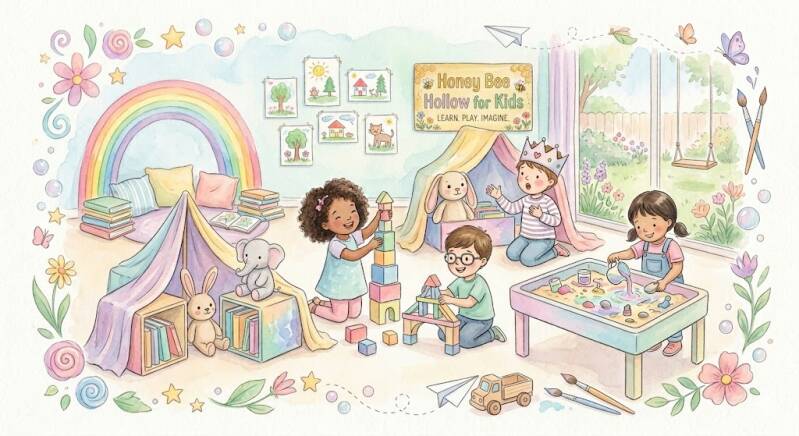
If you’ve ever watched a child spend forty-five minutes trying to fit a square peg into a round hole—or watched a preschooler turn a cardboard box into a multi-level spaceship—you’ve witnessed a masterclass in cognitive development. To the untrained eye, it looks like simple entertainment, but to the developing brain, it is the most sophisticated work imaginable. In the realm of early childhood, play is not a break from learning; it is the primary engine of it.
The Biological Blueprint for Discovery
True learning comes from play because the human brain is biologically wired to absorb information through experience and trial-and-error. When a child engages in free play, they are practicing vital executive functions like planning, negotiating rules, and solving problems on the fly. This active engagement stimulates the release of essential proteins that assist with memory and the growth of new neurons. Unlike passive learning, where a child is simply told a fact, play allows them to discover the mechanical reality of the world firsthand.
This process also builds essential social and emotional intelligence. The playground acts as a microcosm of society where children learn the hard skills of empathy and conflict resolution. They figure out how to share resources and manage the inevitable frustration that comes when a block tower collapses. These moments of self-regulation are the invisible building blocks for emotional resilience and mental health later in life.
Language and Physical Mastery
Language development thrives when children are lost in their own make-believe worlds. Whether they are narrating a story for their toys or negotiating roles in a game of pretend, they are experimenting with vocabulary and complex sentence structures. This internal and external dialogue serves as a bridge to literacy and sophisticated communication.
Simultaneously, play provides the foundation for physical mastery. The fine motor skills required to thread beads and the gross motor skills needed to navigate a jungle gym are about more than just exercise. They develop the hand-eye coordination and spatial awareness necessary for everything from handwriting to advanced mathematics.
Moving Past the Academic Myth
There is a growing pressure to trade playtime for flashcards and formal instruction at increasingly younger ages. However, research consistently shows that pushing formal academics too early can lead to higher anxiety and lower motivation as children grow older. As the legendary Fred Rogers once noted, play is often dismissed as a relief from serious learning, yet for children, play is the most serious learning of all.
Creating Space for Curiosity
Supporting this type of growth does not require expensive gadgets or a rigid curriculum. It simply requires providing the space and the permission for a child to follow their own interests. When adults step back and allow for a bit of boredom, they create the mental vacuum that sparks a child's creativity.
Instead of showing a child the correct way to build a bridge, asking open-ended questions like "I wonder what would happen if we used this piece?" encourages them to lead the investigation. Embracing the mess—whether it involves mud kitchens or scattered building blocks—is a small price to pay for a busy, growing brain.
The Final Word
When we prioritize play, we aren't just giving children a fun afternoon. We are building the foundational scaffolding for critical thinking, resilience, and lifelong curiosity. The next time you see a child deeply immersed in a make-believe world, remember that they aren't just playing; they are preparing to take on the world.
Create Your Own Website With Webador